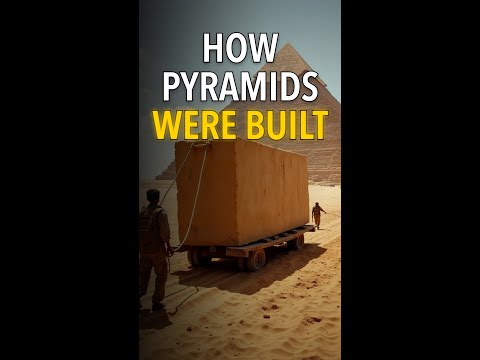
Pyramids Were Not Built By Slaves.They Named Their Teams“Friends Of Khufu” & “Drunkards Of Menkaure”



Leírás
For centuries, one image dominated the story: endless lines of slaves, whipped under the desert sun, dragging stones for god‑kings who treated them as disposable. It appears in films, cartoons, sermons and schoolbooks.
It is wrong.
The pyramids of Giza were built by organised, paid workers. The proof has been sitting under the sand for 4,500 years.
THE HORROR: The horror here is not what happened at Giza. It’s what we chose to believe about it — and why.
In the 1990s, archaeologists excavating south of the Great Pyramid uncovered a large settlement: Heit el‑Ghurab, often called the “Lost City of the Pyramid Builders.” It was not a slave camp. It was a planned workers’ town.
They found:
Long barracks‑like galleries where rotating crews lived.
Industrial bakeries capable of turning out thousands of loaves a day.
Breweries producing thick, calorie‑rich beer — a core staple of the Egyptian diet.
Storage facilities for grain, dried fish and meat.
The animal bones told the rest. Tens of thousands of bones from sheep and goats, and thousands more from cattle and pigs. The diets reconstructed from these remains show regular consumption of beef and other meat — a richer protein intake than most ordinary Egyptians enjoyed. This is not the signature of starving slaves. It is the signature of workers being fed to do heavy labour.
The human skeletons add another layer. Archaeologists have documented healed fractures and spinal injuries with evidence of treatment: broken limbs set and mended, vertebrae showing long‑term strain but survival. Someone cared enough to treat them rather than simply discard them when injured. In systems built entirely on slave labour, injured bodies are replaced, not healed.
Then there are the burials. Just west of the workers’ village, a cemetery of labourers has been found: simple pit graves and small mudbrick tombs, often with pottery jars and offerings of bread and beer placed beside the dead for their journey into the afterlife. Being buried within sight of the pyramids, with the same basic rituals as any Egyptian, is not how slaves are treated. As Zahi Hawass has put it, “If they were slaves, they would not have been buried right next to the kings.”
Administrative texts back this up. Papyri found at Wadi al‑Jarf on the Red Sea coast — some of the oldest papyrus documents yet discovered — describe teams transporting limestone blocks to Giza. They read like work logs and supply records: who hauled what, where they camped, how much food they received. It’s the paperwork of a huge state building project, not an inventory of chained captives.
The work gangs even named themselves. On inner blocks and casing stones, ancient markings record crew names such as “Friends of Khufu” and “Drunkards of Menkaure.” These sound like unit nicknames — half pride, half in‑joke. They do not sound like labels imposed on enslaved people.
THE MODERN RELIC: The workers’ settlement and cemetery at Giza are partly excavated and studied; they lie just beyond the tourist paths, within view of the pyramids themselves. The bakeries, breweries and barracks are there. So are the bones and the tombs.
The idea that the pyramids were built by slaves comes mostly from two later narrative sources, neither of them Egyptian. One is Herodotus, the Greek historian who visited Egypt in the 5th century BC — nearly 2,000 years after the Great Pyramid was built. He wrote down stories told to him by local guides, not accounts from Old Kingdom archives. He was essentially a tourist with a notebook.
The other is the biblical story of Israelite slavery in Egypt from Exodus, which describes forced labour under different pharaohs in a much later era, and on different construction projects. The text itself doesn’t say “pyramids”; that association was made centuries later, mostly in Western imagination, because both involved Egypt and building.
Modern Egyptologists point out that the timeline simply doesn’t match, and the archaeology doesn’t support mass slave labour at Giza. As Dieter Wildung, former director of the Egyptian Museum in Berlin, remarked, “The world simply could not believe the pyramids were built without oppression and forced labour, but out of loyalty to the pharaohs.”
The world needed whip marks in the sand. The sand contains bakeries, breweries, healed bones and honoured graves.
The pyramids were not built by anonymous suffering. They were built by teams of skilled workers, eating bread and beer, proud enough of their crews to paint “Friends of Khufu” and “Drunkards of Menkaure” on the blocks they hauled into place.
HASHTAGS
#darkhistory #ancientegypt #pyramids #historytok #historicalhorror #weirdhistory #archaeology #giza #mythbusting #ghostsandhistory
Pyramids Were Not Built By Slaves.They Named Their Teams“Friends Of Khufu” & “Drunkards Of Menkaure” – Online videóklip leírása
Nézd meg a(z) Pyramids Were Not Built By Slaves.They Named Their Teams“Friends Of Khufu” & “Drunkards Of Menkaure” című zenei videót kiváló minőségben online a videok.top-on! Hallgasd meg a legújabb slágereket és kövesd kedvenc előadóid hivatalos videóklipjeit regisztráció nélkül. Böngéssz a zenei kategóriák között, és fedezd fel a legfrissebb hazai és nemzetközi újdonságokat, koncerteket és dalokat nálunk.
Zenei poén betöltése...
SZÓLJ HOZZÁ